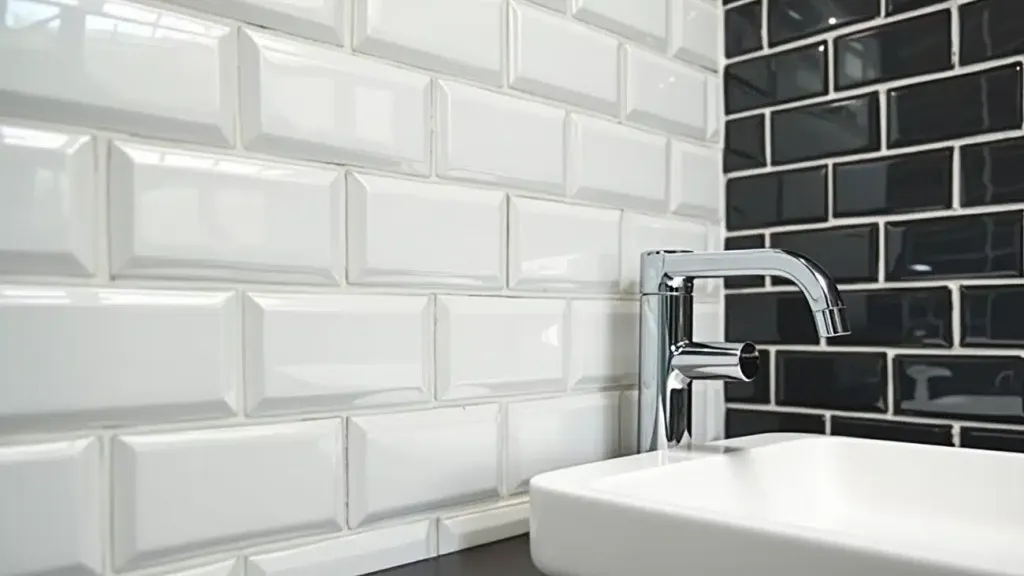
With white tile, grout color decides how strongly you see the pattern. A close color match softens the grid. A darker grout makes each tile and joint more visible.
There isn’t one best color for every white tile. Start with the tile’s undertone and the look you want, then check a real sample in the room.
Choose how much contrast you want
| Grout direction | Likely visual effect | What to check in a sample |
|---|---|---|
| White or near-white | A quieter pattern with less contrast | Whether the grout looks warmer or cooler than the tile |
| Light gray | A visible grid without a strong dark outline | How the gray looks beside cabinets and counters |
| Dark gray or black | A bold outline around each tile | Joint consistency, tile-edge variation, and visible residue |
| Warm beige or greige | A warmer pairing with cream-toned white tile | Whether it looks too yellow or pink under your lights |
These are design observations, not product-performance rankings. White grout isn’t automatically weaker, and dark grout isn’t automatically easier to keep looking clean.
Don’t choose from a screen alone
MAPEI’s grout color palette warns that lighting, preparation, tile type, and screen differences can change how the installed color appears.
Bring home physical samples, then narrow the choice with the actual tile. For a larger job, ask for a small sample board made with the selected grout and joint width. Let it cure as directed before judging it.
Look at the sample in daylight and with the room’s usual lights on. Hold it beside the counter or floor, not against a bright white sheet of paper in another room.
Joint width changes the effect
A narrow joint shows less grout. A wider one gives the color more space in the design.
High contrast also makes irregular edges and uneven spacing easier to see. That may suit handmade tile, where the variation is part of the look. For a quieter wall, a closer color match may be more forgiving visually.
Have the installer establish the joint width the tile requires before making the final color choice. Don’t choose a tiny joint just to hide grout if the tile isn’t suited to it.
Pick the grout product as well as the color
Ask which product is proposed and whether it suits the tile, joint width, and location. Cement-based and ready-to-use or epoxy products have different instructions and care needs.
Some finishes may need a test for staining or scratching. Sealing requirements also depend on the product. A blanket promise that “all grout needs sealer” or “this color never stains” isn’t a useful specification.
Ask how changes of plane and movement joints will be handled, including any compatible color-matched sealant. They aren’t simply another place to pack in grout.
Recoloring an existing installation
If you like the tile but dislike the grout color, ask whether cleaning or a suitable grout colorant is practical. The grout needs to be sound, and the colorant must accept the surface.
Cracked grout, moving tile, or water damage calls for investigation before recoloring. A cosmetic change won’t correct those causes.
Before ordering the full quantity, approve one real sample under your own kitchen or bathroom lights. That small step gives you better evidence than a room photo taken under someone else’s lighting.
Need a Handyman You Can Trust?
Tell us what needs fixing. We’ll help you get a fair quote for the work.